
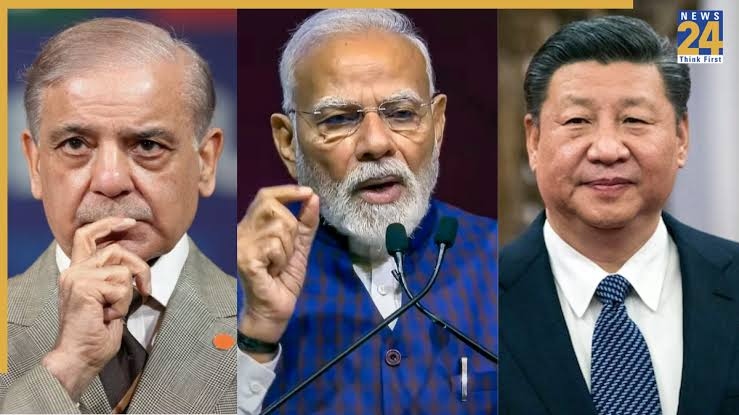
Pakistan and China have formally launched a long-planned joint mechanism for managing their border, establishing a new framework for cooperation on cross-border movement, trade, surveys and communication between authorities.
The inaugural meeting of the Pakistan-China Boundary Joint Commission (BJC) took place in Islamabad on 16 and 17 September, more than a decade after the mechanism was envisaged under a bilateral agreement signed in 2013.
Officials from both countries used the two-day meeting to establish how the commission will operate and identify areas for future coordination. The discussions covered movement of people and goods, joint border surveys, cross-border cooperation and closer links between communities.
At the end of the meeting, the delegations signed minutes reaffirming their consensus and setting out a framework for future work. Pakistan's Foreign Ministry said the next session would take place in China on dates to be agreed by both governments.
The development adds another formal institution to the extensive relationship between Beijing and Islamabad, but it also touches one of South Asia's most sensitive territorial disputes. India has rejected the commission's legal basis and reiterated its objections to arrangements involving territory it claims.
What the New Pakistan-China Commission Will Do
The commission is not the result of a newly negotiated border agreement.
Its origins go back to the 2013 China-Pakistan Agreement on the Boundary Management System, reached during a visit to Pakistan by then Chinese Premier Li Keqiang. The agreement provided for a joint commission responsible for implementing and coordinating border-management arrangements.
Operationalising it now creates a permanent channel through which officials can deal with practical questions along the border rather than relying solely on separate diplomatic contacts.
The first meeting brought together officials from several government bodies, reflecting the breadth of the commission's mandate.
Pakistan's delegation was led by Bilal Mahmood Chaudhary, Director General for China at the Ministry of Foreign Affairs. China's delegation was headed by Li Ya, Deputy Director General of the Department of Boundary and Ocean Affairs at the Chinese Foreign Ministry.
Officials representing foreign affairs, defence, interior, commerce and communications were involved, alongside customs, survey and other authorities responsible for border administration.
That composition indicates that the commission is intended to address more than the physical maintenance of a boundary.
Movement of goods and travellers is particularly significant because the mountainous frontier provides Pakistan with its direct land connection to China.
The Khunjerab Pass, connecting Pakistan's Gilgit-Baltistan region with China's Xinjiang region, is an important part of that relationship. It serves travellers and trade and forms part of the wider connectivity associated with the China-Pakistan Economic Corridor.
Joint surveys and coordination between border authorities could therefore have practical implications for transport, customs procedures and the management of infrastructure in difficult high-altitude terrain.
Why India Has Objected
The launch has also revived a much older territorial disagreement involving India, Pakistan and China.
New Delhi has rejected the Boundary Joint Commission and argues that arrangements involving areas it regards as Indian territory cannot have legal validity.
India's Ministry of External Affairs maintains that Jammu and Kashmir and Ladakh are integral parts of India and disputes Pakistan's authority to enter into territorial arrangements concerning areas under Pakistani administration that India claims.
At the centre of the historical disagreement is the 1963 China-Pakistan boundary agreement.
That agreement established arrangements covering the frontier between China's Xinjiang region and territory administered by Pakistan. India has never accepted the agreement and has long disputed China's control of the Shaksgam Valley, which New Delhi considers part of the former princely state of Jammu and Kashmir.
The territorial dispute also intersects with India's opposition to the China-Pakistan Economic Corridor (CPEC). New Delhi objects to CPEC projects passing through areas administered by Pakistan but claimed by India.
Pakistan and China reject India's position on the bilateral border mechanism and continue to treat their existing agreements as the basis for cooperation.
The competing claims mean the commission has two different interpretations depending on the government describing it: Islamabad and Beijing present it as a practical mechanism for managing their border, while New Delhi disputes the legal foundation of arrangements affecting territory it claims.
Border Management Becomes Part of a Wider Strategic Relationship
The commission's launch comes against the background of increasingly institutionalised ties between Pakistan and China.
The relationship already extends across infrastructure, energy, defence, investment and trade, with CPEC remaining one of its most prominent economic components.
For Pakistan, improving the operation of its northern connection with China could support efforts to increase trade and make cross-border transport more predictable. For Beijing, reliable transport links with Pakistan form part of a broader network of economic and strategic relationships across South and Central Asia.
Pakistan's Foreign Ministry described the establishment of the commission as an important development in what the two governments officially call their “All-Weather Strategic Cooperative Partnership.”
The inaugural meeting itself did not announce a new territorial settlement or change the existing boundary arrangements. Its immediate significance is institutional: officials from the two countries now have a formal mechanism through which border issues can be discussed on a continuing basis.
What happens next will depend on how extensively that mechanism is used.
The two sides have already agreed that the second Boundary Joint Commission meeting will be held in China, although no date has yet been announced.
Future meetings could provide a clearer indication of whether the commission remains primarily administrative or develops into a broader platform for trade facilitation and infrastructure coordination.
For now, its launch demonstrates the continuing depth of Pakistan-China cooperation while simultaneously highlighting the unresolved territorial disagreements that continue to shape relations among Pakistan, China and India.